
 |
|||||||
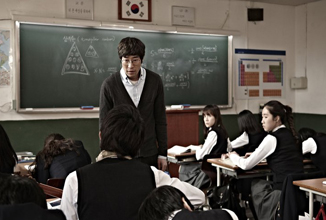
Synopsis: Seok-go (Ryoo Seung-beom) is a quiet and seemingly unassuming maths teacher living alone in a Seoul apartment block. Deeply enamoured with his neighbour, Hwa-seon (Lee Yo-won), he visits the cafe where she works each lunchtime without fail - always ordering the same takeaway food - but, try as he might, his shyness repeatedly prevents him from connecting with her on an emotional level; managing only an almost embarrassed 'hello' and 'thank you' he walks away frustrated and unfulfilled on each occasion.
Review: What would you be prepared to do for love? More than that, if someone told you they "did it for love" would you assume they meant love for someone or love from someone?
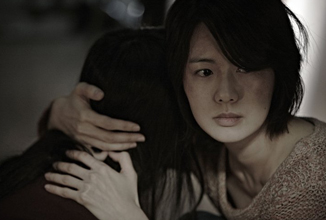
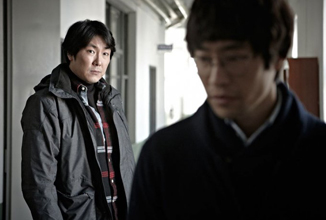
More than once during the course of the film, reference is made to a classical mathematical theorem that Seok-go has been obsessed with trying to prove since his school days. However, in helping Hwa-seon hide her crime his focus increasingly shifts from a sole preoccupation with the concept of a Perfect Number to a deep-rooted intellectual and emotional need to maintain her alibi and thereby create the perfect murder. This is added to yet further by the third piece in the character puzzle; that of Min-beom (Jo Jin-woong), the police detective in charge of the case who is also an old school friend of Seok-go: Ultimately, for all his intelligence Seok-go is set to find an answer he didn't even know he was looking for... the answer to the question "In a battle between heart and mind, which will win?"
Big Boobs Babe Portable PageAnother factor is the way curvy women are often portrayed in popular culture. From pin-up girls to celebrities, women with voluptuous figures have been a staple of entertainment and media for decades. This representation has helped to normalize and celebrate curvy bodies, making them more relatable and desirable. In recent years, there has been a growing movement towards body positivity and self-acceptance. The “Big Boobs Babe” phenomenon can be seen as a part of this movement, where women with curvy figures are embracing their bodies and celebrating their uniqueness. Social media platforms have provided a space for these women to share their stories, connect with others, and challenge traditional beauty standards. However, the ideal body shape has varied across cultures and throughout history. In some cultures, a curvy figure is seen as a symbol of beauty and prosperity, while in others, a slender figure is preferred. The media and societal beauty standards have also played a significant role in shaping our perceptions of beauty. Big Boobs Babe The term “Big Boobs Babe” has become a popular phrase used to describe women with voluptuous figures, particularly those with larger busts. But what is it about these women that captivates the attention of so many people? Is it purely physical attraction, or is there something more to it? The Allure of Voluptuous Figures: Understanding the Fascination with Curvy Women** Another factor is the way curvy women are To understand the fascination with curvy women, we need to delve into the complexities of human attraction and the cultural significance of body shape. Research suggests that humans are wired to respond to certain physical characteristics, such as a curvy figure, as a sign of fertility and health. This attraction is deeply rooted in our evolutionary past, where a woman’s body shape and size were indicators of her reproductive potential. In conclusion, the fascination with “Big Boobs Babes” is complex and multifaceted. While physical attraction plays a role, it is also about confidence, cultural significance, and the celebration of diversity. By embracing and accepting all body types, we can work towards a more inclusive and accepting society, where everyone can feel valued and appreciated. In recent years, there has been a growing One of the key factors that contribute to the allure of curvy women is confidence. Women who are comfortable in their own skin and confident in their appearance are often seen as more attractive and charismatic. This confidence can be infectious, making others feel more at ease and drawn to them. DVD The DVD edition reviewed here is the Korean (Region 3) Art Service Limited Edition First Press version. The film itself is provided as an anamorphic transfer with an aspect ratio of 2.35:1 and there are no image artifacts (and no ghosting) present.
'Perfect Number'
- Commentary by director Bang Eun-jin, Ryoo Seung-beom and Jo Jin-woong
|
|||||||
All images © Art Service Review © Paul Quinn |
|||||||